
CA mourns death of Khaleda ZiaNation loses a great guardian: CA
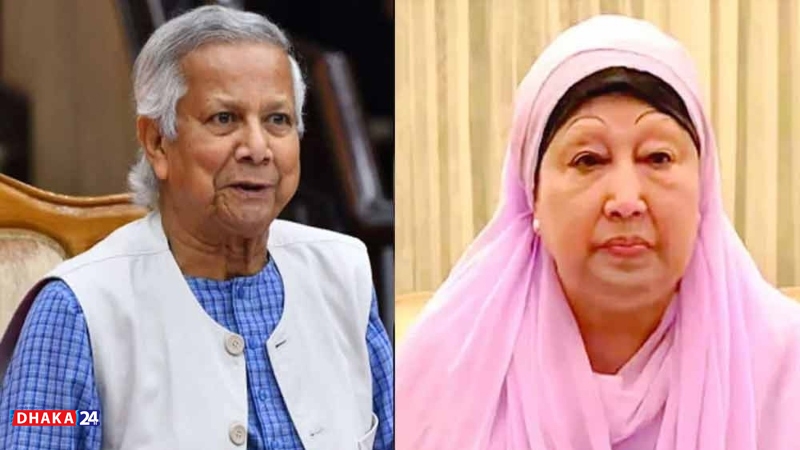 The Chief Adviser (CA) of the Interim Government Professor Muhammad Yunus has expressed deep sorrow at the death of Begum Khaleda Zia, three-time former prime minister, symbol of the democratic movement, and chairperson of the Bangladesh Nationalist Party (BNP).
In a condolence message, the Chief Adviser said, “With the passing of Begum Khaleda Zia, the nation has lost one of its great guardians. I am deeply saddened and shocked by her death. Begum Khaleda Zia was not merely the leader of a political party; she was an important chapter in the history of Bangladesh. Considering her contributions, her long political struggle, and the deep public affection for her, the government declared her a Very Very Important Person of the State earlier this month.”
“Her role in the struggle to establish democracy, a multiparty political culture, and the rights of the people in Bangladesh will be remembered forever. Through her uncompromising leadership, the nation was repeatedly liberated from undemocratic conditions and inspired to reclaim freedom. The nation will remember her contributions to the country and its people with deep respect,” he added.
Despite political differences, he said, Khaleda Zia’s long political journey, people-oriented leadership, and steadfast determination consistently guided the nation toward the greater good. “With her death, the country has lost a seasoned and tested stateswoman,” The Chief Adviser noted.
The Chief Adviser further said that Begum Khaleda Zia was Bangladesh’s first woman Prime Minister and BNP chairperson who led the struggle to restore democracy against authoritarian rule.
He said that following the death of her husband—former president, army chief, and Valiant (Bir) Freedom Fighter Ziaur Rahman — Begum Khaleda Zia entered politics in 1982 after years as a homemaker. Her strong leadership played a decisive role in bringing down the nine-year-long autocratic rule of General H. M. Ershad.
The Chief Adviser noted that many of Khaleda Zia’s actions and decisions helped move the country forward. “She introduced free education and stipend programs for girls, which are considered milestones in the advancement of women’s education in Bangladesh,” he said.
He also said that Begum Khaleda Zia was remarkably successful in her political career and was never defeated in an election. “Between 1991 and 2001, she was elected from five different parliamentary constituencies in general elections. In 2008, she won all three constituencies from which she contested,” he said.
After becoming Prime Minister in 1991, he added, she laid a strong foundation for the country’s economy through economic liberalisation.
Referring to the later years of her life, the Chief Adviser said that during what he described as Sheikh Hasina’s fascist rule, Begum Khaleda Zia became a unique symbol of struggle and resistance. “Her uncompromising stance powerfully inspired the nation throughout prolonged movements and protests,” he said.
He further said that due to her political success, Begum Khaleda Zia became a victim of extreme political vendetta. “She was sentenced to 17 years in prison in false and fabricated cases and had to endure prolonged incarceration,” he said.
Expressing deep sympathy, the Chief Adviser conveyed condolences to her bereaved family and party leaders and activists. On this day of irreparable national loss, he urged the people to remain calm and patient, and requested everyone to offer prayers for the departed leader from their respective positions.
প্রধান সম্পাদক: রাছেল খাঁন | মোবাইল : +৮৮ ০১৮৫৯ ৫৫১৫৫৫ বাউনিয়া,বটতলা,তুরাগ, উত্তরা,ঢাকা-১২৩০।
 প্রিন্ট করুন
 সেভ করুন